

'Assistance approach' favored in mental health encounters
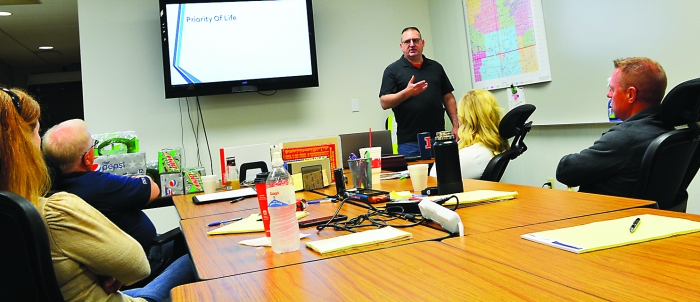
Humboldt Police Chief Joel Sanders (center) talks to local law enforcement personnel during a recent daylong training session about how to deal with people undergoing mental health crisis. Humboldt Independent photo by Kent Thompson.
By KENT THOMPSON
There has been a lot of talk during the past year about police reform. Voices seeking change have come from the local, state and national levels of government.
One aspect of police reform that Humboldt Police Chief Joel Sanders has been working on for several years is mental health awareness and how officers under his command and others in law enforcement see citizens who may be demonstrating signs and symptoms of mental health crisis.
Sanders, who took over in January as Humboldt’s first police chief in more than a decade, has an extensive background and interest in mental health and its relationship to 21st century community policing. He recently offered a daylong mental health training class to the seven Humboldt police officers and two members of the Humboldt County Sheriff's Office.
“Originally, several years ago, I was asked to put together an eight-hour course for every police officer in Champaign County, which was over 300 officers. Originally I identified an international curriculum, which was pretty decent for civilians, but wasn’t all that practical for law enforcement. I took that and reworked it and develop a class I call R.E.S.E.T.," Sanders said.
R.E.S.E.T. stands for five things law enforcement can do to provide a safe and effective response to an individual demonstrating behaviors consistent with a person in mental health crisis. They are:
• Recognize the behavior
• Evaluate the situation
• Slow down
• Engage the individual
• Treat (the person) with dignity and respect
Read more about how law enforcement can more effectively deal with people in mental health crisis in this week's Humboldt Independent.

