

Radon – a colorless, odorless killer
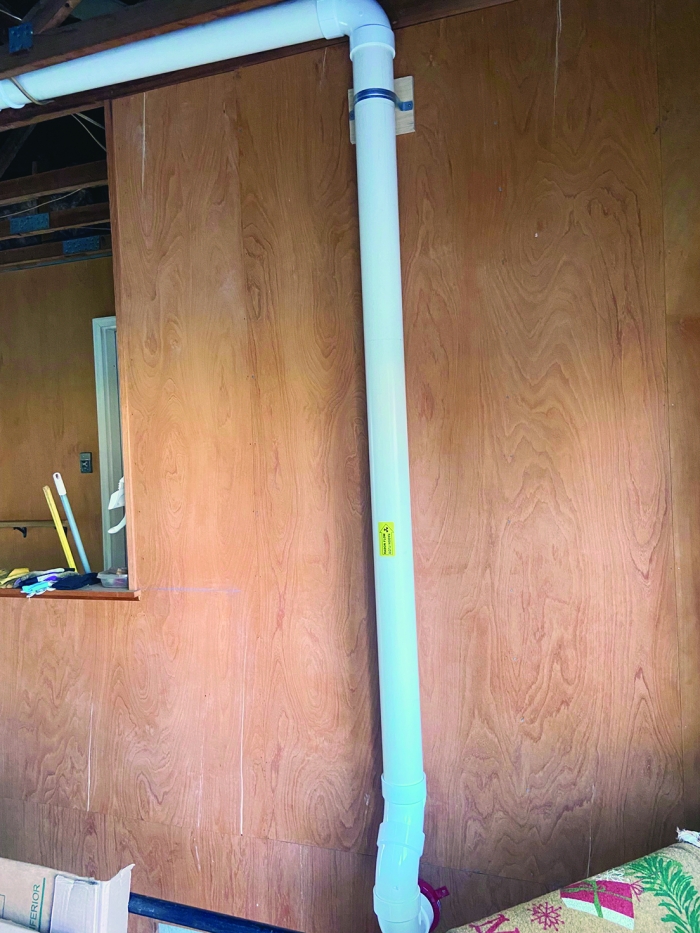
Jason Christensen with Iowa Radon Mitigation Co. installs a pipe that allows the radon trapped below the concrete to safely move to be dispersed to the outdoors, where it is less concentrated. Submitted photo.
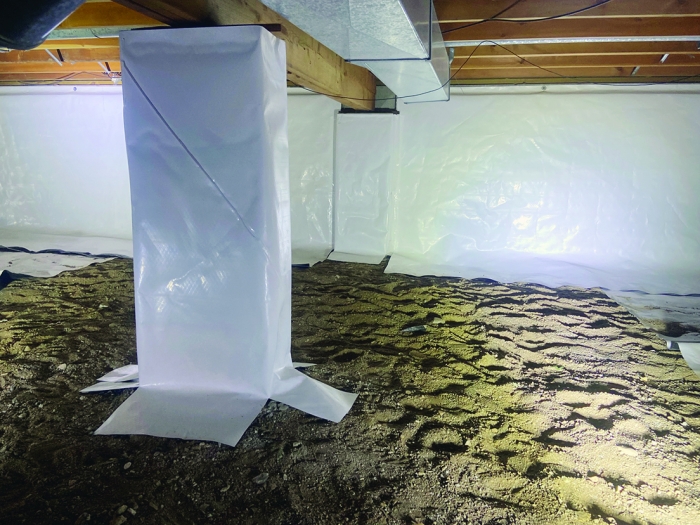
Houses with a crawl space face the same issues as houses with a basement in terms of radon seeping into the house. Jason Christensen with Iowa Radon Mitigation Co. places thick plastic to encapsulate the walls and then pipes the radon safely out from under the house.
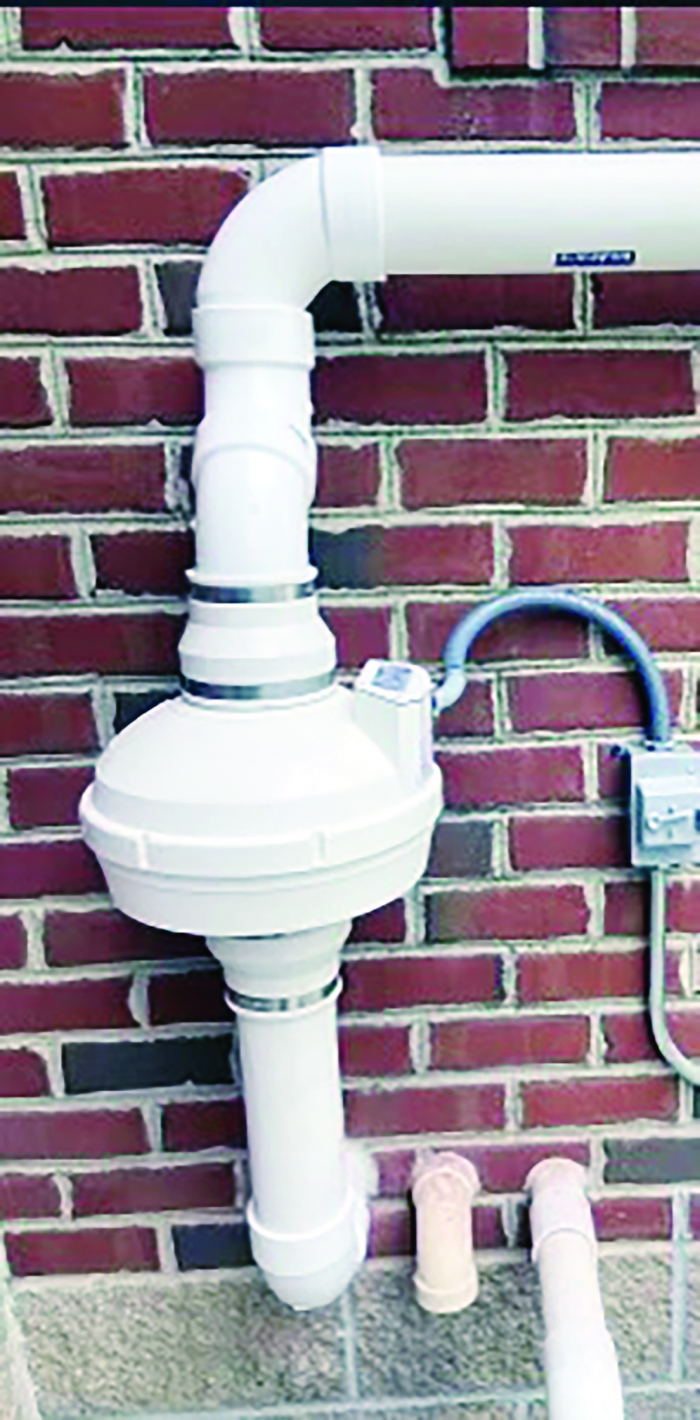
Jason Christensen with Iowa Radon Mitigation Co. places a fan system outside the house which connects to the pipe in the underground system, wicking the radon out of the house to a livable level.
By APRIL KELLEY
Iowa has the second-highest rate of new cancer cases in the United States and of those cases, lung cancer is third most diagnosed form of cancer.
While most everyone knows that smoking is the leading cause of lung cancer, Iowa also is in the top 10 of the second common cause of lung cancer, radon.
Radon is a colorless, odorless gas that naturally occurs in soil. It is a radioactive gas that is produced by the decay of uranium in soil, rock and water.
Iowa has several features that cause radon levels to rise including uranium-rich bedrock (limestone) and glacial deposits that had high radium content.
The Iowa Cancer Consortium website states that five in seven homes in Iowa have high radon levels. It can build up in homes, even seeping through concrete floors, walls, floor drains and sump pumps.
According to Christen Sewell with Humboldt County Public Health, the best way to protect against lung cancer after quitting smoking is to mitigate radon.
“Governor Reynolds created the Combat Cancer Grant and as part of the grant they are distributing 30,000 radon test kits statewide,” Sewell said.
“Marion County Public Health was awarded the full contract but Humboldt (County Public Health) is partnering with them to give out free test kits to any homeowner in Humboldt County,” Sewell continued.
The kit is a small pouch that is hung between eye and knee level in the lowest living level of the home away from drafts, moisture and direct sunlight.
The pouch remains in place for three to seven days and then the homeowner sends it back to the lab to be analyzed. Public Health and the homeowner receive a report.
If the results come back with a high concentration of radon, which is anything over four picocuries (the unit of measure for radon), then the test is repeated by a professional.
Humboldt County Public health has partnered with Jason Christensen with Iowa Radon Mitigation Co.
Christiansen has a background in plumbing and HVAC systems so when more people began to look at radon mitigation, he felt that it would fit right in with his background.
“We had a bunch of people asking about doing radon testing or radon mitigation systems. I'm also friends with a few realtors in Fort Dodge, and they said, "Hey, you should do this," Christiansen said.
Christensen decided to become a radon specialist, anticipating that this will continue to be an issue in Humboldt County.
If a test comes back with elevated levels, Christiansen follows up with another test to ensure that the results are accurate.
If the second test comes back with an elevated level, mitigation steps are recommended.
“I also do some diagnostic testing when I am at a home for mitigation to help me get a better idea of entry points and problem areas,” Christensen said.
A radon mitigation system consists of a vent-pipe and fan set up called an Active Soil Depressurization (ASD) system.
It pulls radon from beneath the home and exhausts it outdoors, significantly reducing the levels of radon in the home.
“When I put in systems, I like to get down, if at all possible, to around one picocurie. Some homes are more difficult to mitigate than others and sometimes that required some creative problem solving and extra work to get levels as low as reasonably achievable," Christensen said.
In May of this year, the governor signed a law that all new single- and two-family homes built after July 1, must be built with a passive radon mitigation system, but Sewell warns that it is still prudent to check the levels on occasion.
A passive radon mitigation system is one where there is a pipe that goes under the foundation to facilitate the flow of radon to the outdoors. It does not have a fan like the ASD system does.
“If the levels remain high in a new home build, they would need to put in a system with a fan then,” Christensen said.
Just because a person has a crawl space instead of a basement may not mean that they are off the hook.
“If you have a crawl space, what I have to do is a crawl space encapsulation, which involves plasticizing the entire crawl space. I run a strip drain. It’s a tile underneath used to move air underneath that plastic. So basically I'm making my own barrier for radon entry, and then I'm moving air underneath that,” Christensen said.
Both Sewell and Christensen admit that the most important thing to do at first is to just get tested.
“It is possible that neighbors don’t have the same levels in their house and there isn’t any reason for it, it just is,” Sewell said.
“It’s important that everyone tests their house, even if their neighbor's house tests ok,” Christensen said.
“We just want to get as many of these kits out as possible. We have gotten out about 40 already and have gotten six back. All six have been high and needed further testing,” Sewell said.
The grant has some funds available for mitigation to homeowners who qualify.
“There are some requirements. They are going to ask you the value of your home and your income and then the cost of the mitigation,” Sewell said.
“So it’s important to get a kit soon and test your home right away,” Christensen said.
To receive a kit, stop into Humboldt County Public Health on the southwest side of the hospital or call 515-332-2492 for more information.
“Beyond quitting smoking, it is the second best thing you can do to stop lung cancer and it’s very easy to do. The free test kits make it even easier,” Sewell said.
Homeowners with questions regarding radon can also contact Christensen directly at 515-269-0147 or by email at iowaradonmitigationco@gmail.com.
Disclaimer:
This project is supported by the Centers for Medicare & Medicaid Services (CMS) of the U.S. Department of Health and Human Services (HHS) as part of a financial assistance award totaling $209,040,063.71 with 100 percent funded by CMS/HHS. The contents are those of the author(s) and do not necessarily represent the official views of, nor an endorsement, by the Iowa Department of Health and Human Services, CMS/HHS, or the U.S. Government.

